
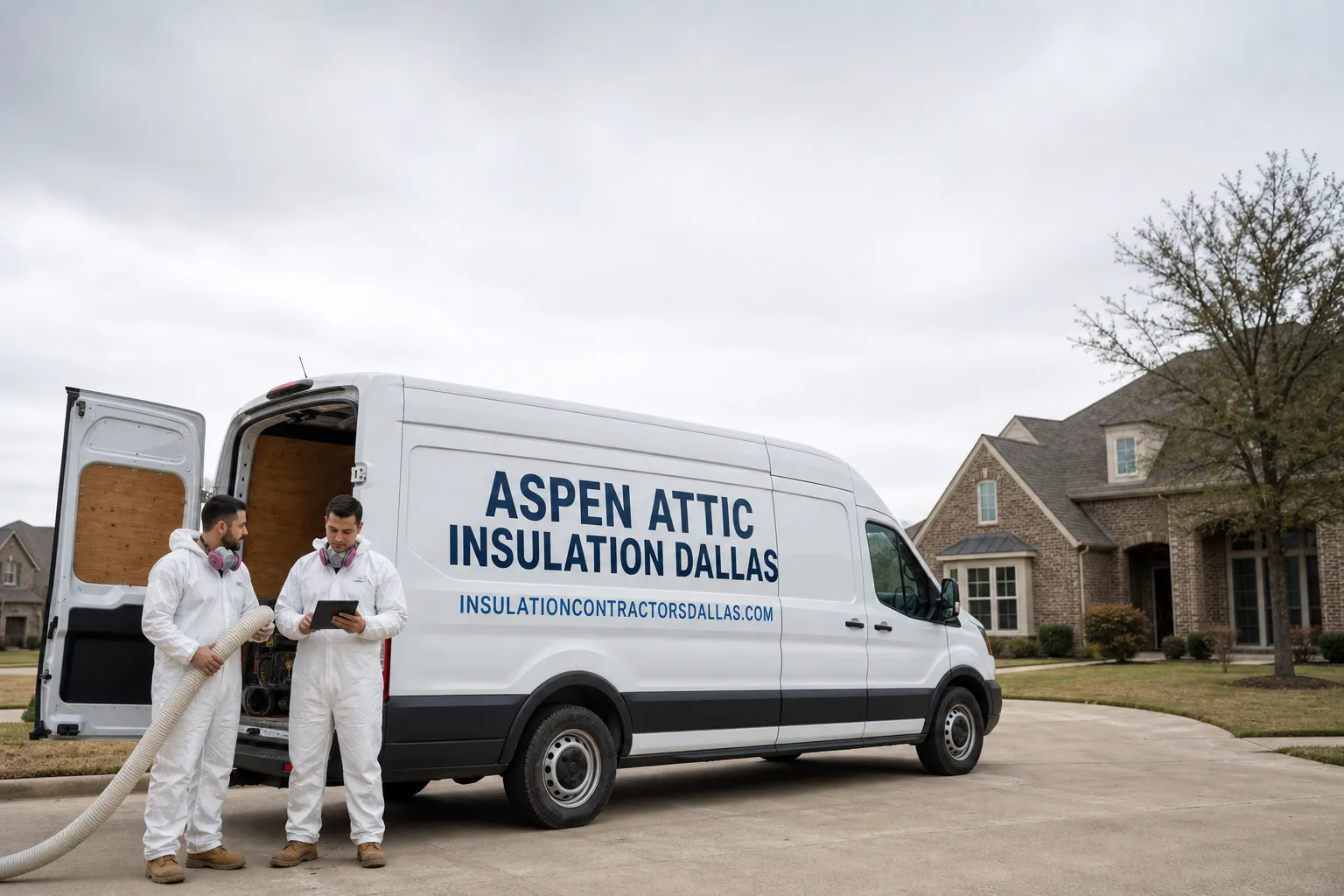
Fast, Reliable Blown In Insulation Across Plano
Blown-in insulation in Plano typically costs $1.50 to $3.80 per square foot installed, depending on material choice and how much removal work is needed first. Most Plano attics we service need between 1,200 and 2,000 square feet of coverage. For a standard single-family home in Plano, that puts the full project somewhere between $1,800 and $7,600. Call (361) 607-0906 and we’ll give you a written price before any work begins.
If your Plano home was built between 1970 and 2000, there’s a real chance the attic insulation has quietly failed. We see it in Prestonwood, along Coit Road through central Plano, and up through the Legacy corridor. The original fiberglass batts compress. Heat creeps in. Your AC runs harder than it should. We’ve been called “the Plano attic thermal company of record for older construction” and we’ll show up in a clean uniform with a photo ID badge and a written estimate.
Why Aspen Attic Insulation Dallas Is Plano’s Preferred Blown In Insulation Company
Plano has hundreds of homes with identical original insulation: thin R-19 fiberglass batts laid in the 1980s across vented attics. We see the same failure pattern constantly. Batts pushed flat by decades of storage and HVAC service visits no longer hold the R-value stamped on the bag.
Our Plano customers tell us the same thing: they had a hint something was wrong – hot upstairs bedrooms, a ceiling that radiated heat at night – but nobody had actually climbed up to measure the existing batt thickness before we arrived. We do. Every estimate in Plano includes an attic inspection with depth measurements and a written price before work starts.
Garrett Sloane, our owner, insists that every Plano customer knows exactly who is arriving. Your technician’s name and photo are sent before the appointment. The tech arrives in a marked uniform, shows an ID badge at the door, and walks you through the work before touching a hose. That’s the Threshold Standard, and it’s how every Aspen Attic Insulation Dallas visit runs.
Response time to most Plano neighborhoods – including the 75023, 75025, and 75093 ZIP codes – is same-day or next-day for estimates. We answer the phone with a live person, 24/7, no voicemail loop.
Blown In Insulation Contractors in Plano
Blown In Insulation Contractors in Plano do more than run a hose into the attic – the job starts with figuring out why the old insulation stopped working. For most Plano homes built before 2000, the answer is simple: age, compression, and pest disturbance. We remove what needs removing, air-seal where heat and humidity are getting through, and blow in fresh insulation to tested depth.
Attic Air Leak Sealing First
In Plano’s vented attics, air moves through top plates, around can lights, and along plumbing vents. Blowing insulation over those gaps without sealing first is like wearing a jacket in the wind. We seal before we blow. Always.
Blown-In Insulation for Older Plano Attics
Older Plano attics often have uneven joist cavities and low-slope areas where batts never fit right in the first place. Blown-in loose fill gets into the corners and over the top plates evenly, which is exactly what a 1980s production-built attic needs. Our Blown In Insulation team runs the hoses for a full day on most Plano homes.
Cellulose Insulation in Plano
Cellulose Insulation is the material we recommend most often for Plano attic retrofit projects. It’s made from recycled paper treated with borate, and it’s blown in as loose fiber that fills every irregular gap. In a Plano attic with compressed R-19 batts, removing the failed material and blowing cellulose to R-38 is the most reliable fix we know.
Dense-Pack Cellulose for Slab-Foundation Homes
Plano’s slab foundations and brick veneers are fine structural choices, but they don’t breathe. That means attic ventilation matters more, not less. Dense-pack cellulose holds its shape better than loose fiberglass in Plano’s humid summer air, which keeps the R-value where we set it.
Rodent and Pest Recovery
Plano’s older subdivisions – especially Prestonwood and along Legacy – have pest activity in attics more often than homeowners expect. Rodents nest in fiberglass, leaving it soiled and compacted. We remove the contaminated material safely, treat the area, and blow in fresh cellulose. You get a clean attic and a full R-value.
Trusted Brands We Service in Plano
We stock GreenFiber, CertainTeed, and Demilec materials for our Plano jobs. GreenFiber cellulose is our standard for blown-in retrofits – it fills narrow cavities, holds its depth, and stands up to North Texas humidity better than most loose fiberglass. CertainTeed blow-in fiberglass is on hand for Plano homeowners who prefer fiberglass on principle, and we use Demilec spray foam for rim-joist sealing and odd penetrations where a hose can’t get the density we need. No Plano job waits for a distributor to ship.
Common Blown In Insulation Problems We See in Plano Homes
- Compressed original batts. The R-19 fiberglass installed in 1970s-1990s Plano homes often measures under R-11 today. Years of attic storage and HVAC technicians walking through the attic press the fiberglass flat, and a flat batt doesn’t resist heat gain.
- Pest-disturbed insulation. Rats, mice, and squirrels in Prestonwood and other older Plano subdivisions tunnel through fiberglass, leave droppings, and push aside insulation to create bare ceiling areas. Those bare spots lead to hot rooms and high cooling bills.
- Humidity soaks into blown-in fiberglass. Plano’s humid summers push moisture into vented attics, and loose fiberglass can absorb enough of that moisture to lose R-value. Cellulose holds up better here.
- Radiant barrier with inadequate insulation below it. Many Plano homes got radiant barrier decking installed, but the insulation underneath still sits at R-19 or worse. Radiant barrier reflects some heat, but it doesn’t replace proper attic insulation. Blown-in cellulose over a radiant barrier roof is a strong combination in Plano.
Pricing for Blown In Insulation in Plano, TX
For a standard Plano single-family home, removing failed fiberglass batts, air-sealing top plates and penetrations, and blowing in GreenFiber cellulose to R-38 usually runs $3,400 to $6,900. Smaller attics or homes that just need a top-off over existing insulation fall around $1,800 to $2,900. If you’re hearing a much lower number from someone else, ask what depth they’re actually blowing and whether removal is included. We give you the full written price before work starts, and it covers labor and materials. Free estimates. Call (361) 607-0906 for your number.
We Also Serve Cities Near Plano
Our crews work throughout Plano and the surrounding North Dallas suburbs. If you’re in Richardson, Addison, Sachse, or Dallas, we can handle your blown-in insulation the same way – written price first, named technician at the door, 365-day guarantee. Dispatch is coordinated from our Dallas-Fort Worth office, and Plano jobs are scheduled locally.
Serving Plano, TX - Our Local Coverage Area
We’re based in the Plano area and know this community well. Use the map below to see our service coverage - if you’re nearby, we can almost certainly help.
FAQs About Blown In Insulation in Plano
If your Plano home was built before 2000 and still has the original attic insulation, it’s almost certainly underperforming. Look for hot upstairs rooms, AC that runs constantly in August, and ceiling drywall that feels warm after sunset. The only way to know for sure is to measure the batt depth – we do that as part of every free estimate. Call (361) 607-0906 and we’ll check it in an hour.
For Plano’s climate, we blow cellulose to R-38 in most attics. That’s roughly 12 to 13 inches of settled cellulose, and it performs well against Plano’s summer heat. Some larger attics or homes with special HVAC loads do better at R-49, and we’ll tell you honestly which applies to your house before you pay anything.
Yes, and in fact the combination works better than either one alone. Radiant barrier reflects some radiant heat, but it stops working if the air below it gets too hot. Blown-in cellulose slows heat flow through the ceiling, keeping the attic air cooler and the radiant barrier effective. For Plano homes with radiant barrier decking, we recommend blowing cellulose to the same R-38 depth we would use anywhere else.
It helps indirectly. Insulation alone doesn’t dry out an attic, but cellulose resists moisture better than loose fiberglass and keeps the ceiling plane cooler, which reduces condensation against the decking. For genuinely humid Plano attics, we often recommend air-sealing and a ventilation check alongside the insulation work. A sealed, ventilated attic with R-38 cellulose holds up well through a Plano summer.
If the existing batts are dry, clean, and still holding their shape, you can blow over them. Most of the 1970s-1990s Plano attics we inspect don’t meet that standard – the batts are compressed flat or contaminated with pest droppings. In those cases, removing the failed batts first gives the new insulation a clean, even surface and a true R-value. We’ll show you photos from the attic so you can see exactly what’s up there before deciding.
Written by Garrett Sloane, Owner at Aspen Attic Insulation Dallas, serving Plano with the Threshold Standard since 2002.