
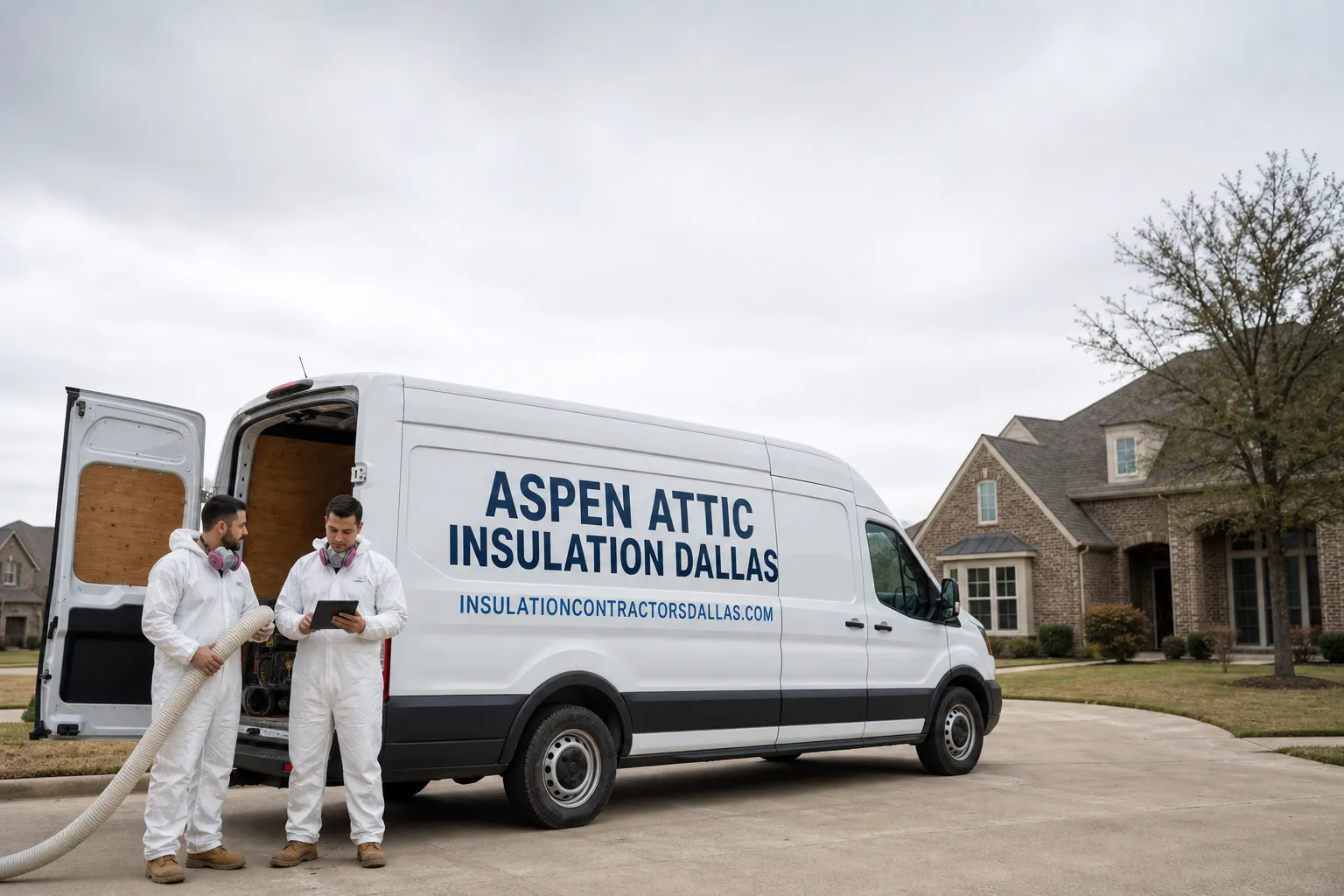
How Much Does Attic Insulation Cost in Dallas?
Attic insulation in Dallas typically costs between $1.50 and $4.80 per square foot installed, with most homeowners paying $1,650 to $3,400 for a standard 1,000 to 1,500 square foot attic. Blown-in fiberglass runs on the lower end of that range, while spray foam lands at the top. The exact number depends on what’s already up there, how much needs to come out, and the R-value you’re targeting for a Dallas summer.
Get a written quote before any work starts. Aspen Attic Insulation Dallas gives every homeowner a firm price in writing, with no surprise line items added after the crew leaves. Call (361) 607-0906 and a live person will answer.
Key Takeaways
- Average total cost in Dallas: $1,650 to $3,400 for a standard attic.
- Per-square-foot range: $1.50 to $4.80, depending on material and R-value.
- Blown-in fiberglass: $1.50 to $2.90 per square foot installed.
- Blown-in cellulose: $1.70 to $3.10 per square foot installed.
- Spray foam (open-cell): $2.50 to $4.80 per square foot installed.
- Old insulation removal: $0.80 to $2.00 per square foot when it’s needed.
- Payback period: Most Dallas homeowners break even in 2 to 5 years on energy savings alone.
Want a number for your exact attic? Call (361) 607-0906. The estimate is free, and the price we quote is the price you pay. Garrett Sloane and his team put that in writing.
Attic Insulation Cost Breakdown (2026)
Here’s what homeowners in Dallas are paying for attic insulation in 2026. These ranges reflect the local market, including labor for a standard single-story home with accessible attic space.
| Item | Cost Range (Installed) | Notes |
|---|---|---|
| Blown-in fiberglass (R-30 to R-38) | $1.50 – $2.90 per sq ft | Most popular option for re-insulating existing attics |
| Blown-in cellulose (R-30 to R-38) | $1.70 – $3.10 per sq ft | Denser coverage; handles Dallas heat well |
| Fiberglass batt (R-30) | $1.40 – $2.75 per sq ft | Best for open, unobstructed attic floors |
| Open-cell spray foam (R-21 per 5.5 inches) | $2.50 – $4.80 per sq ft | Air-seals as it insulates; ideal for roofline application |
| Old insulation removal | $0.80 – $2.00 per sq ft | Required after rodent damage or heavy soiling |
| Air sealing (prep work) | $250 – $800 total | Caulking, foam sealing around penetrations, top plates |
| Attic access hatch insulation | $75 – $200 | Small job, big heat leak if skipped |
For a 1,200 square foot attic, blown-in fiberglass usually falls between $1,800 and $3,500 including basic air sealing. Spray foam on the roofline for the same footprint runs $3,000 to $5,700. Those are honest spreads, not teaser numbers.
Dallas gets 225 to 240 days per year above 90°F in a typical recent decade, and attics regularly hit 140°F and beyond. That heat loads directly onto whatever R-value stands between your ceiling and the roof deck. Under-insulated attics cost Dallas homeowners an extra $400 to $900 per year in cooling, which is why the math on adding insulation usually works fast.
What Affects Attic Insulation Pricing in Dallas
Pricing moves for specific reasons, not randomly. Here’s what actually shifts the number on your quote.
- Current insulation level. If you’re starting at R-11 or R-19 from a build in the 1980s or 1990s, adding blown-in fiberglass to reach R-38 is straightforward and costs less than a full removal-and-replace. If the existing insulation is compressed, wet from a roof leak, or packed with rodent droppings, removal adds $0.80 to $2.00 per square foot before new material goes in.
- Access and attic layout. Tight attic access hatches, steep roof pitches, and attics crisscrossed with HVAC ductwork slow the install and add labor. Homes in older Dallas neighborhoods, the M Streets and Lakewood in particular, often have lower attic clearances that require more time per square foot.
- R-value target. Dallas sits in Climate Zone 3, where the Department of Energy recommends R-30 to R-49 for attics. Every step up in R-value means more material. Going from R-30 to R-49 on 1,200 square feet typically adds $350 to $700 in material alone.
- Material type. Spray foam costs more per square foot than blown-in materials, but it air-seals and insulates in one pass, which can eliminate the separate air-sealing line item. Cellulose runs slightly higher than fiberglass but performs better in blocking radiant heat transfer, which matters in a Dallas attic.
- Air sealing scope. Recessed lights, bathroom fan housings, plumbing vents, and the attic hatch all leak conditioned air. Sealing those correctly before insulating adds labor and material, but skipping it is a false economy. In Dallas, we regularly find houses losing 15 to 25% of their cooled air through attic bypasses.
- Season. Demand spikes in May, June, and July as the first heat waves hit. Houston doesn’t have that problem in the same way, but Dallas’s hotter, drier summers push homeowners to schedule insulation work right as AC bills jump. Scheduling in fall or early spring can mean lower rates and faster availability.
Insulation Types Available in Dallas, TX
You have three main choices in the Dallas market. Here’s the straight version of what each one does.
Blown-In Fiberglass
Loose fiberglass fibers are blown through a hose into the attic cavity, filling gaps around joists, pipes, and wiring. It’s the most common re-insulation approach in Dallas because it’s efficient to install and the per-square-foot cost is the lowest of the three. R-value runs about 2.2 to 2.7 per inch, so reaching R-38 means roughly 14 to 17 inches of depth.
Aspen Attic Insulation Dallas uses Johns Manville and Owens Corning blown-in fiberglass for most retrofit jobs. These two brands have consistent, predictable R-values per inch, which means the depth we quote delivers the R-value we promise.
Blown-In Cellulose
Cellulose is denser than fiberglass and does a better job of stopping airflow through the material itself, which helps when you can’t fully air-seal due to attic configuration. It’s made from recycled paper treated with fire retardant. In a Dallas attic, that density means it resists the natural settling that can reduce effective R-value over time. GreenFiber is our go-to cellulose product.
Spray Foam
Spray foam expands to fill cracks, gaps, and voids, creating an air barrier and an insulation layer in one application. Open-cell foam is the standard choice for attic rooflines in Dallas because it performs well in our heat and allows some moisture permeability. Closed-cell foam is available but overkill for most Dallas attic applications, and it costs roughly double.
For spray foam work, we use Icynene and Demilec products. These are not interchangeable with any generic “foam” product, and the difference in density, expansion rate, and long-term stability is measurable. If a quote doesn’t name the foam brand, ask why.
Signs Your Attic Insulation Needs Replacement
Replacement costs run higher than a simple top-up because removal and disposal are involved. Here’s what tells you whether you’re in the top-up or replace category.
- High cooling bills while the rest of the house is fine. If your upstairs rooms run 8 to 10 degrees warmer than the thermostat reading in the living room, and the AC is less than 10 years old, the attic is a likely culprit.
- Rodent activity. Squirrels and roof rats leave urine, feces, and chewed material in the insulation. That material can’t be simply covered over. Removal and sanitization, then new insulation, is the only correct fix. In neighborhoods like Lake Highlands and Preston Hollow with mature tree canopies, we see this regularly.
- Water staining or mold on the insulation surface. A past roof leak that went undetected compresses fiberglass and ruins cellulose. Once wet, R-value drops permanently. Replacement is necessary.
- Attic temperature that matches outdoor temperature. If your attic is 110°F at 9 a.m. in June, your insulation has stopped doing its job. The attic should stay noticeably cooler than the outside air if it’s properly insulated and ventilated.
How Much Does Attic Insulation Cost by Material in Dallas?
For quick reference, here’s the material-specific pricing for the average Dallas attic between 1,000 and 1,500 square feet.
- Blown-in fiberglass, full attic, R-38: $1,800 – $3,200
- Blown-in cellulose, full attic, R-38: $2,000 – $3,600
- Fiberglass batts, full attic, R-30: $1,600 – $3,000
- Open-cell spray foam on roofline: $3,000 – $5,800
- Removal plus blown-in replacement: $3,800 – $6,500
We quote the materials by name. If you want Owens Corning fiberglass, Rockwool batts, or Demilec foam, that’s what goes on the written estimate and what arrives on the truck. No substituting whatever is “available at the supplier that week.” Garrett Sloane’s policy on this is straightforward: the quote names the material, the tech installs that material.
How to Save on Attic Insulation
Insulation is not where you want to cut corners, but there are real ways to reduce the total without sacrificing performance.
- Schedule work in fall or early spring. Dallas insulation contractors are busiest from May through August. Booking in October or November often means better pricing and more scheduling flexibility.
- Combine air sealing with the insulation job. Doing air sealing as a separate visit costs more than doing it during the same trip. One mobilization, one set of permits if needed, one cleanup.
- Check for utility rebates. Oncor and Atmos Energy have historically run insulation rebate programs for Dallas homeowners. These change frequently, but a $300 to $600 rebate is not uncommon when programs are active. Ask your contractor if they handle the paperwork.
- Fix roof leaks first. Paying to insulate, then paying again to re-insulate after a leak, is the most expensive way to learn about your roof. Any contractor who doesn’t ask about roof condition before quoting is skipping a basic step.
- Get multiple written quotes, and compare the line items. Not just the bottom number. What R-value are you actually getting? What material? Is removal included? Aspen gives you a written price with these line items broken out before work starts. Call (361) 607-0906 and we’ll do exactly that.
FAQs – Attic Insulation Cost
How much does attic insulation cost in Dallas, TX?
Most Dallas homeowners pay between $1,650 and $3,400 to insulate a standard attic in 2026. The per-square-foot range runs from $1.50 for blown-in fiberglass to $4.80 for spray foam. Your number depends on attic size, current insulation, and target R-value. Call (361) 607-0906 for a written quote on your specific attic, free of charge.
Is it cheaper to add insulation or replace it?
Adding insulation, called a top-up, costs $1.50 to $2.90 per square foot. Full removal and replacement runs $3.80 to $6.50 per square foot when you include removal, disposal, and new material. If your existing insulation is dry, uncontaminated, and not compressed, a top-up is almost always the right financial choice. We’ll tell you honestly which category your attic falls into.
How much does spray foam insulation cost in Dallas?
Open-cell spray foam on the attic roofline in Dallas typically costs $2.50 to $4.80 per square foot installed, so a 1,200 square foot attic lands between $3,000 and $5,800. It costs more than blown-in options, but it air-seals and insulates in one step. For a firm quote on Icynene or Demilec foam, call (361) 607-0906.
Can you insulate my attic in one day?
Yes. Most blown-in and batt insulation jobs in Dallas are completed in one day, including setup and cleanup. Spray foam jobs sometimes run into a second day for large or complex attic configurations. When you call Gary’s team at (361) 607-0906, we’ll tell you the expected timeline before you commit to anything.
How quickly will attic insulation lower my energy bills?
Dallas homeowners typically see cooling bill reductions of 15 to 25% in the first full summer after installing proper attic insulation. That translates to $400 to $900 per year in savings for most homes, which means a $2,500 insulation job pays for itself in roughly 3 to 6 years. The performance is consistent, but the exact dollar figure depends on your AC system, home size, and thermostat habits.
What to Expect From Aspen Attic Insulation Dallas
Here’s how it works when you call us. A live person answers, 24/7, day or night. No voicemail loops, no call-back windows. You tell us about your attic, and we schedule a time that works for you.
Before the technician arrives, you receive the tech’s name and photo. That’s the Threshold Standard: every technician is background-checked, identity-verified, arrives in a clean marked uniform, and shows a photo ID badge at the door. If anyone other than the named tech shows up, the visit is free and we make it right.
You get a written price before any work begins. Not a verbal estimate, not a “ballpark,” not a range. A written price, broken down by line item, with the material brand named on the page. Once you approve it, that’s the number. No post-job surprises.
Every job carries the 365-Day Done Right Promise. It covers labor and materials for a full year, in writing. If something isn’t right, we send a second visit free. That’s the whole promise. No fine print gymnastics.
Aspen Attic Insulation Dallas is part of the Threshold Group family, founded in 2002. We carry eight premium material brands: Owens Corning, Johns Manville, Knauf, Rockwool, CertainTeed, Icynene, Demilec, and GreenFiber. The right product goes in for your attic, not just the one sitting on our warehouse shelf.
We handle all three core services: attic insulation in Dallas, spray foam, and blown-in insulation. Our home page covers the full range of what we do.
One call gets you a firm answer. (361) 607-0906. You’ll talk to a person, you’ll get a real quote, and you’ll know exactly who’s coming to your door.
Pricing reflects the Dallas market as of 2026. Aspen Attic Insulation Dallas offers free estimates – call (361) 607-0906.
Written by Garrett Sloane, Owner at Aspen Attic Insulation Dallas. Garrett has managed attic insulation projects across the Dallas metro since 2002 and leads a team that works to the Threshold Verified standard on every job.
What Our Customers Say
"Honest assessment. Told me the walls were fine and the attic was the problem. Saved me money."
- Ed M."Quiet crew and a neat attic. Rooms stay even now."
- Jill K."Spray foam in the rim joists of the crawl space. Clean install, and the floors are noticeably warmer."
- Chuck W.