
How Much Does Attic Air Sealing Cost in Dallas?
Attic air sealing in Dallas, TX typically costs between $1,200 and $2,800 for a standard single-family home, with most homeowners paying around $1,800 to $2,200 for a complete job that includes sealing the attic floor, top plates, penetrations, and the attic hatch. Smaller jobs focused only on the attic hatch and visible bypasses can run $400 to $800. Larger homes with complex rooflines, recessed lighting, or multiple attic access points can push the total to $3,500 or more.
That price includes the labor, the sealant materials, and in most cases a blower door test before and after the work, which tells us exactly how much air leakage we stopped. If you’re calling around Dallas, you’ll hear numbers all over the map. We’ll tell you why in a minute, but first you should know the price depends more on your home’s construction than on which company you call.
Attic Air Sealing Cost Breakdown (2026)
Here’s what the line items look like on a typical Dallas attic air sealing job. These are real numbers from our work across the metro area in 2026.
| Line Item | Typical Range | Notes |
|---|---|---|
| Attic inspection & blower door test | $150 – $300 | Often credited back if you proceed with sealing |
| Sealing attic floor penetrations (wires, pipes, ducts) | $400 – $900 | Includes top plates in most homes |
| Attic hatch / pull-down stair cover | $150 – $400 | Insulated cover box installed over the opening |
| Recessed light sealing (per fixture) | $25 – $60 each | Homes with 10+ can lights add up fast |
| Knee wall & soffit sealing (if applicable) | $300 – $700 | Common in older Dallas ranches and two-story homes |
| Chase & flue sealing (chimney, plumbing stacks) | $150 – $400 | Requires fire-rated materials around flues |
| Foam sealant & caulk materials | $100 – $250 | Fire-rated foam costs more than standard |
| Final blower door verification | Included | Most DFW companies fold this into the job total |
What Drives the Price Up or Down
Attic air sealing is labor-intensive work. The biggest cost driver is your attic’s accessibility and how many penetrations exist in the attic floor. A 1960s ranch in Lake Highlands with a low-pitched roof, a tight crawl to the eaves, and fifty years of added wiring will cost more than a clean 2015 build in Frisco with a roomy attic and modern construction.
Recessed lighting is another big one. Older can lights leak air constantly, and sealing them properly means installing rated covers or replacing the fixtures entirely. If you have 15 can lights across your ceiling, that’s $375 to $900 just for the lights. Homes with pull-down attic stairs almost always need a stair cover, which adds $150 to $400 but stops a surprising amount of air movement.
We also see price differences based on whether the job includes the attic hatch and any knee walls. Two-story Dallas homes with cathedral ceilings and framed knee walls have more leakage points than a simple single-story with a flat ceiling. That’s not a bad thing, it just means more sealing work.
What Affects Attic Air Sealing Pricing in Dallas
- Attic square footage and roof pitch. A 1,500-square-foot attic with a 4/12 pitch takes less time to work in than a 3,000-square-foot attic with a 10/12 pitch. Steep roofs mean more crawling, more time, more labor cost.
- Number of penetrations in the attic floor. Every wire, pipe, duct, and vent creates a gap. Older Dallas homes in neighborhoods like Casa Linda, Forest Hills, and Richardson’s Canyon Creek tend to have more of these than newer builds in Celina or Anna.
- Recessed lighting count. Can lights are basically holes in your ceiling. Sealing them correctly is material- and labor-intensive, and the count varies wildly from house to house.
- Access points. A single attic hatch is quick. Three access points, a pull-down stair, and a tight scuttle in a closet add hours to the job.
- Presence of knee walls or vaulted ceilings. Homes with bonus rooms, dormers, or angled ceilings create awkward sealing areas that require more foam, more patience, and more time.
- Age of the home. Pre-1990 construction in Dallas was rarely sealed at all. We often find entire top plates unsealed, old fiberboard sheathing with gaps, and chases that run straight from the crawlspace to the attic. Newer homes still need sealing, but the starting point is usually better.
Is Attic Air Sealing Worth the Cost in Dallas?
For most Dallas homeowners, yes. The math is straightforward: air sealing typically cuts 10% to 20% off your annual heating and cooling costs. In a climate where July and August push attic temperatures past 130 degrees, and where January nights dip below freezing, that’s real money. A home spending $2,400 per year on heating and cooling can expect to save roughly $240 to $480 per year after sealing.
At a sealing cost of $1,800 to $2,200, you’re looking at a 4- to 9-year payback from energy savings alone. But the comfort improvement usually feels immediate. Sealed attics mean fewer drafts, more even temperatures between rooms, and less dust pulling through the house. Many Dallas homeowners tell us the upstairs bedroom that was always 8 degrees warmer in summer finally matches the rest of the house.
Attic air sealing also extends the life of your insulation. When air moves through fiberglass or blown-in insulation, it reduces the insulation’s effective R-value. Seal the air gaps and your existing insulation suddenly works the way it was designed to. That’s why we frequently recommend attic air sealing in Dallas as a first step before adding insulation.
Attic Air Sealing vs. Adding Insulation: What’s the Difference?
Insulation slows heat transfer. Air sealing stops air movement. They’re different problems with different solutions. In the Dallas market, we see plenty of homes with R-30 or even R-38 insulation that still feel drafty and cost too much to cool. The insulation is fine. The air leaks are the problem.
Think of it this way: insulation is the sweater, air sealing is the windbreaker. On a cold Dallas day, a sweater works fine until the wind blows through it. The windbreaker stops that. In your attic, the wind is the air moving through unsealed top plates, wire penetrations, and plumbing chases.
Most Dallas homes benefit from doing both. We recommend sealing first, then adding insulation on top. That’s because the sealing work needs to happen at the attic floor level, where the gaps are. Once you seal those, the insulation goes on cleanly and performs at its rated value from day one. If you want to learn more about insulation options, our home page covers the three insulation services we offer across the metro area.
How the Air Sealing Process Works
We start with a blower door test. That’s a calibrated fan mounted in your front door frame that depressurizes the house and measures exactly how much air is leaking. The test gives us a baseline number in CFM (cubic feet per minute). In Dallas, most unsealed homes from the 1970s and 1980s measure between 2,000 and 3,500 CFM. A tight, well-sealed home might measure under 1,500.
After the baseline test, technicians go into the attic and start sealing. The main targets are:
- Top plates – the horizontal boards where walls meet the attic floor. These get sealed with fire-rated foam or caulk along every seam.
- Wire penetrations – every electrical wire that enters the attic from the walls below creates a small but real gap.
- Plumbing vents and chases – plumbing stacks and framed chases that run from the basement or crawlspace up to the attic are major air highways.
- Duct penetrations – where supply and return ducts pass through the attic floor.
- Recessed lights – covered with rated boxes or sealed per manufacturer specifications.
- The attic hatch – the access opening itself, which often leaks more air than all the other penetrations combined if left unsealed.
After sealing, we run the blower door test again. The difference between the before and after numbers tells you, in hard CFM terms, how much air leakage we eliminated. That’s the verification step most companies skip. We don’t, because we want you to see exactly what you paid for.
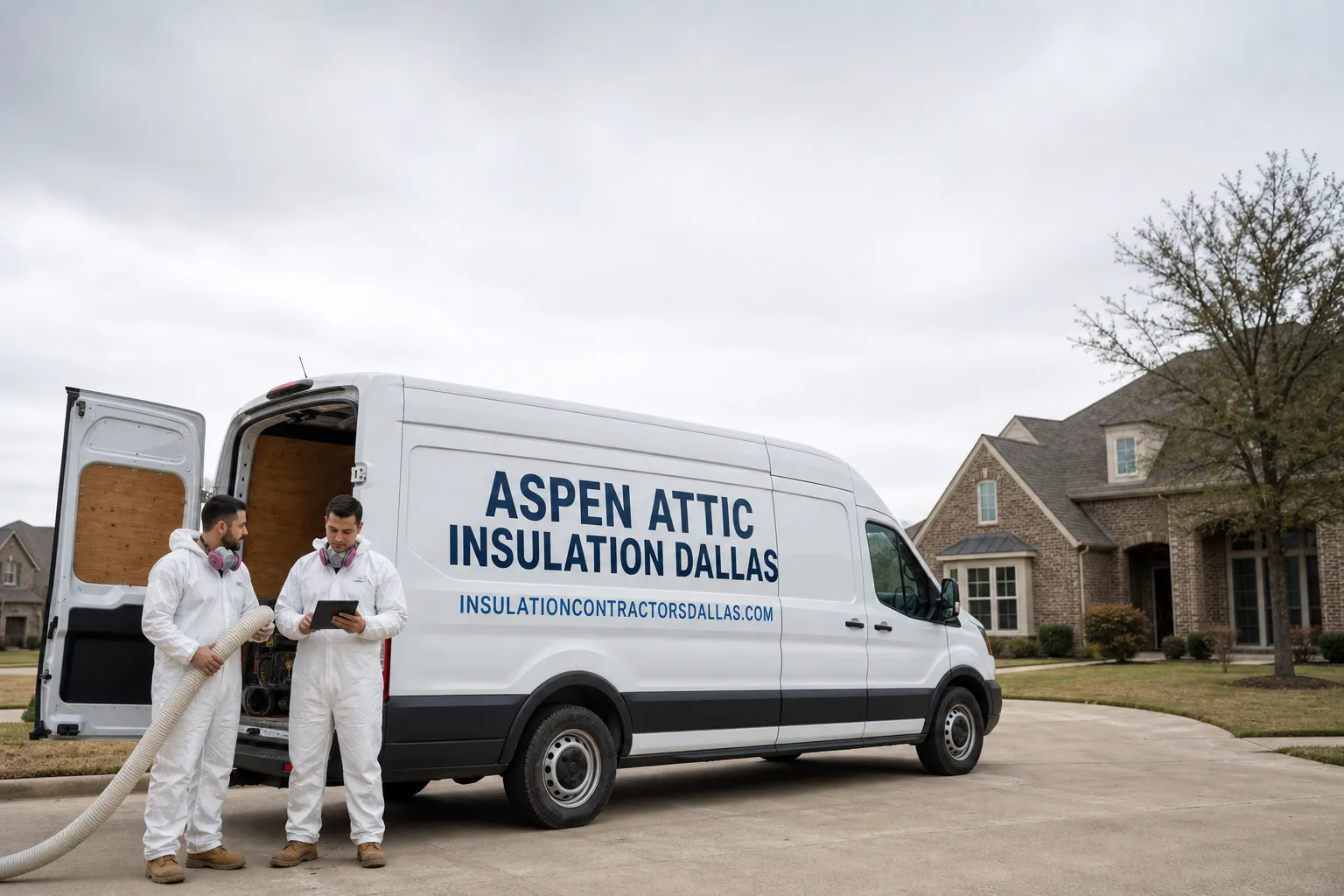
Every Aspen Attic Insulation technician working in your attic is background-checked, identity-verified, and arrives in a clean marked uniform with a photo ID badge at the door. You’ll get the technician’s name and photo before the visit, so when someone knocks, you know exactly who it is. That’s part of the Threshold Standard that every Aspen location follows.
How to Save on Attic Air Sealing in Dallas
There are a few legitimate ways to reduce the cost of attic air sealing without cutting corners:
- Bundle sealing with insulation. If you’re planning to add insulation anyway, doing both at once saves on mobilization, inspection, and setup costs. It’s usually the single biggest discount.
- Seal during the off-season. Spring and fall are slower for most insulation companies in Dallas. Scheduling in March to May or September to November can sometimes get you a better rate and faster scheduling.
- Check for utility rebates. Oncor and some Dallas-area municipal utilities have offered rebates for air sealing and insulation work in recent years. Programs change, so call us and we’ll help you check what’s current.
- Handle the easy stuff yourself. Sealing the attic hatch with weatherstripping and adding a basic hatch cover is a manageable DIY project. Leave the attic floor penetration sealing to a pro, but the hatch is a reasonable weekend job that saves $150 to $400.
- Get a written quote before work starts. This sounds obvious, but it matters. With Aspen, you get the price in writing before any work begins, and that written price is what you pay. No post-job surprises. Get a few quotes, compare line items, and make sure you know what’s included.
We offer free estimates, which means you can get a real number for your specific house without paying for it. Call (361) 607-0906 and we’ll walk through your home’s details, schedule a visit, and get you a written price.
Why Air Sealing Prices Vary So Much in Dallas
Call five companies and you’ll get five different numbers, sometimes spread by $2,000 or more. There are real reasons for that. Some companies quote sealing as part of a larger insulation package and fold the cost into the insulation line item. Others quote sealing alone, which looks higher but covers the same work.
Some companies don’t do a blower door test at all. They’ll spray a little foam around visible gaps and call it sealed. That’s not real air sealing. A legitimate air sealing job includes before-and-after testing, because without the test you can’t verify anything was actually accomplished.
Material quality matters too. Fire-rated foam costs more than standard expanding foam, but around chimney flues and gas vents it’s the only code-compliant option. Some companies skip it to save money. We don’t, because cutting corners around a flue is a safety issue, not a savings opportunity.
Finally, the labor itself matters. Crawling through a 130-degree Dallas attic in August is hard work. Companies that pay their technicians well and verify their backgrounds charge more, and the work reflects it. We’ve never had a customer regret paying for a trained, background-checked technician who showed up on time and did the job right the first time.
How Much Does It Cost to Air Seal a 2,000 Sq Ft Home in Dallas?
For a typical 2,000 square foot single-story home in Dallas, expect to pay between $1,500 and $2,500 for complete attic air sealing. That assumes standard construction, a single attic access point, and a normal number of penetrations. Two-story homes of the same square footage often run $200 to $500 more because of the added complexity around stairwells, knee walls, and double top plates.
How Much Does It Cost to Seal and Insulate an Attic in Dallas?
Combined air sealing and blown-in insulation for a 2,000 square foot attic typically runs $3,500 to $5,500 in Dallas, depending on the insulation type and target R-value. Most Dallas homes are under-insulated by modern standards, and bringing an attic up to R-38 or R-49 while sealing the air leaks is a common whole-attic project. The sealing portion of that number is the $1,500 to $2,500 above, with insulation filling out the rest.
How Much Does Spray Foam Attic Sealing Cost in Dallas?
Spray foam attic sealing is a different animal. Instead of sealing the floor penetrations, spray foam is applied to the roofline itself, creating an unvented conditioned attic. That runs $4,000 to $9,000 for a typical Dallas home. It’s more expensive than traditional floor sealing, but it effectively eliminates attic air leakage entirely and can dramatically reduce attic temperature. We use Icynene and Demilec spray foam products for these jobs.
Common Air Leakage Points We Find in Dallas Homes
Every house is different, but after years of working in Dallas-area attics, certain patterns repeat. Older homes in East Dallas and Oak Cliff almost always have unsealed top plates across the entire attic floor. Homes built in the 1990s around Plano and Carrollton tend to have better top plate sealing but more recessed light leakage. Mid-century homes in North Dallas frequently have whole-house fan openings that were never properly sealed after the fan was removed.
Chases running from the garage to the attic are another common one, especially in homes with water heaters in the garage. The chase around the flue pipe is often wide open, pulling garage air directly into the attic. That’s a code issue and an air quality issue, and it shows up constantly in our inspections.
Air Sealing and Indoor Air Quality
One of the underappreciated benefits of attic air sealing is improved indoor air quality. When your attic has air leaks, the stack effect pulls air up from the crawlspace or basement, through your living space, and out through the attic. That means the air you breathe inside your house is partially coming from wherever the air below you is coming from. Sealing the attic slows that airflow and keeps conditioned, filtered air where it belongs.
We see this clearly in Dallas homes with older ductwork. The air leaks around the ducts pull dust and insulation particles into the house. After sealing, homeowners report less dust on furniture, fewer allergy symptoms, and a house that feels generally cleaner. It’s not the main reason to seal, but it’s a real benefit.
Does Attic Air Sealing Qualify for the 2026 Federal Tax Credit?
As of 2026, attic air sealing qualifies for the federal Energy Efficient Home Improvement Credit when it meets the eligibility requirements. The credit covers up to 30% of the project cost, capped at $1,200 per year for air sealing and insulation combined. That’s a meaningful chunk of the project cost, and it changes the math on payback period significantly. We can’t give tax advice, but we can point you to the IRS form and help you understand what documentation you need from us for your filing.
FAQs – Attic Air Sealing Cost
Is it cheaper to air seal myself or hire a professional in Dallas?
DIY air sealing costs $150 to $400 in materials for foam, caulk, weatherstripping, and a hatch cover, but you won’t get a blower door test, you won’t reach the hard-to-access areas without crawling through your own attic, and you won’t have written verification of what was sealed. Professional sealing in Dallas costs $1,200 to $2,800, and includes testing, full access sealing, and the labor. For most homeowners, the professional route is worth it. Call (361) 607-0906 for a free estimate and a written price.
How long does attic air sealing take?
Most Dallas attic air sealing jobs take 4 to 8 hours for a standard single-family home. Larger homes or attics with lots of recessed lighting can take a full day or more. The blower door test adds about an hour total across the before and after testing. We’ll give you a clear timeline when we provide your written estimate.
Will attic air sealing make my house too tight?
For the vast majority of Dallas homes, no. Most houses in our market leak far more air than is healthy, often 2,000 to 3,500 CFM. Sealing brings that number down to 1,200 to 1,800 CFM, which is still above the threshold where mechanical ventilation would be needed. Only in rare cases, typically new high-performance construction, does a house become too tight. The blower door test tells us exactly where you stand.
Does attic air sealing reduce my electric bill in summer?
Yes. Most Dallas homeowners see 10% to 20% reduction in cooling costs after air sealing, which for a $200 average summer electric bill means $20 to $40 per month in savings. The reduction comes from stopping hot attic air from being pulled into the living space and conditioned air from leaking into the attic. Your exact savings depend on how leaky the attic was to begin with, which the blower door test quantifies.
How much does it cost to seal an attic hatch in Dallas?
Sealing and insulating an attic hatch or pull-down stair in Dallas typically costs $150 to $400, including materials and labor. That’s one of the most cost-effective sealing projects you can do, since the attic access is usually the single biggest air leak in the entire attic. Call (361) 607-0906 for an exact quote – estimates are free.
Can you come seal my attic today?
Sometimes. We keep same-day and next-day slots open for urgent sealing jobs, especially in peak summer when Dallas homeowners are dealing with 100-degree heat and failing AC systems. Call (361) 607-0906 and a live person will answer 24/7, check availability, and get you scheduled.
What’s the difference between a $1,200 air sealing job and a $3,500 one?
Access, penetrations, and testing. A $1,200 job is typically a smaller attic with basic access, few recessed lights, and straightforward sealing needs. A $3,500 job usually involves a larger or more complex attic, multiple access points, knee walls, many recessed lights, and extensive top plate sealing. Both include before-and-after blower door testing if the company is legitimate. Without that testing, you’re paying for a service you can’t verify.
Get a Written Price for Attic Air Sealing in Dallas
We believe you should know the price before you commit to the work. Not a ballpark. Not an estimate that changes later. A written price, in your hand, before any work starts. That’s how we’ve operated since 2002, and it’s the only way we know how to work.
Every Aspen Attic Insulation technician is background-checked, identity-verified, and photo-badged. We send you the technician’s name and photo before the visit. You’ll see a marked uniform and an ID badge at the door. If anything ever isn’t done right, our 365-Day Done Right Promise covers labor and materials for a full year, with a free second visit if a repair fails.
Call (361) 607-0906 for a free attic air sealing estimate. A live person answers, day or night, and we’ll get you a written price for your exact home. No pressure, no surprises, no unknown stranger at your door. That’s the whole point of the way we work.
Pricing reflects the Dallas market as of 2026. Aspen Attic Insulation Dallas offers free estimates, call (361) 607-0906.
Written by Garrett Sloane, Owner at Aspen Attic Insulation Dallas, serving Dallas homeowners since 2002.
What Our Customers Say
"Blown in cellulose up to R-49 in the attic. Tech badged in at the door and measured the depth with a ruler before and after. Upstairs bedrooms stopped being an oven."
- Fran T."Attic hatch got an insulated cover and weatherstrip too. Small thing, big difference."
- Pam J."Vetted crew, which I liked. Installed baffles at the eaves so the vents stay clear."
- Sonia B.